

How can you scale production without overextending your team, budget, or facility? For small and mid-size manufacturers, the real risk isn’t just falling behind competitors. It’s the hidden costs of not automating inefficient, manual, or under-automated operations.
Doosan Robotics America helps manufacturers minimize these hidden costs through collaborative robot (cobot) solutions that are scalable, flexible, and proven. ONExia-branded solutions provided by Doosan Robotics, including the PalletizUR, PalletizHD, and PalletizCRX, deliver fast, targeted wins without disrupting your operations or requiring massive infrastructure changes.
What Are the Hidden Costs of Not Automating or Delaying Automation?
The cost of not automating goes beyond payroll. Manual processes come with a long list of operational inefficiencies that drain time, waste materials, and limit your ability to scale.
These include:
- Inconsistent throughput due to labor variation or fatigue
- Quality issues that increase scrap and rework
- Line bottlenecks that reduce overall efficiency
- Staffing instability in hard-to-fill, repetitive roles
- Missed opportunities due to limited capacity
Most of these costs don’t show up on your balance sheet as a single line item, which is why they’re so often overlooked. But over time, they add up, and they’re why manufacturing inefficiency costs tend to increase year over year unless addressed.
According to research on the hidden cost of downtime, even brief interruptions can result in significant financial loss. Add in the hidden cost of not automating, and you’re looking at a long-term drag on performance and profitability.
How Much Does Downtime Really Cost?
If you’re relying on manual labor for repetitive processes, downtime is unavoidable. Setup times, shift changes, unplanned breaks, and injuries all cut into productive hours. And while each delay might seem small, the cumulative loss can be huge.
Using a downtime cost calculator helps you quantify the real impact. Multiply your average output per hour by your margin per unit, then by hours of unproductive time per week. That number often surprises manufacturers and shows how fast an investment in automation can pay for itself.
Collaborative palletizers like the ONExia PalletizUR or PalletizHD, deployed through Doosan Robotics America, can eliminate the downtime associated with end-of-line manual stacking, allowing your lines to run longer with fewer interruptions.
How Does Automation Reduce Scrap and Rework?
Manual tasks, especially those involving precision or repetition, are prone to human error. Fatigue, inconsistency, and variability all contribute to mistakes that lead to defective products.
Automation helps solve that. Cobots deliver:
- Repeatable motion and accuracy
- Consistent placement and timing
- Reduced operator-related variation
- Stable output across all shifts
This adds up to measurable scrap and rework reduction. If your team is spending time redoing work or sorting out defects, it may be time to look into how cobots can dramatically reduce errors.
What Labor Issues Can Cobots Address?
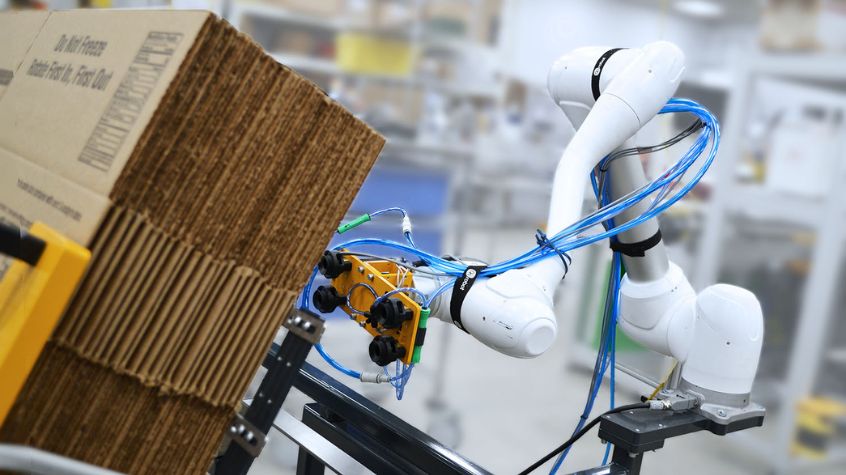
Repetitive motion tasks lead to burnout, turnover, and safety risks. These roles are notoriously difficult to staff and even harder to keep filled. Many small manufacturers are already experiencing the pressure of high turnover, short-handed shifts, and rising labor costs.
Cobots don’t replace workers. They support them by taking on repetitive, injury-prone tasks. This creates more stable, attractive jobs and frees up your team to focus on higher-value work.
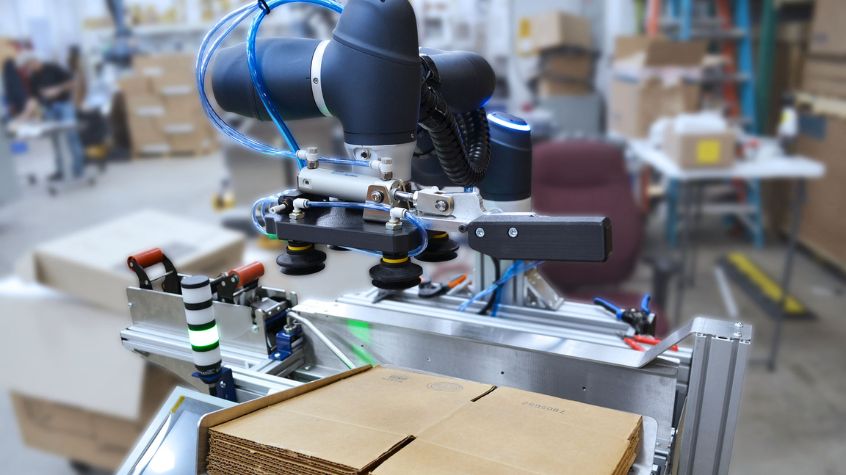
ONExia-branded solutions such as the PalletizUR, PalletizHD, and PalletizCRX are designed by Doosan Robotics America to integrate into your workflow quickly, offering relief at critical pressure points like palletizing and case handling. For example, cobot case erectors are being used to streamline packaging lines without increasing headcount.
Is Automation Affordable for Small Manufacturers?
Yes, especially when implemented incrementally. Many small and mid-size manufacturers begin with one cobot system focused on a high-cost pain point, often after recognizing the hidden costs of not automating a specific manual process.
Some of the easiest areas to start include:
- End-of-line palletizing
- Box forming and sealing
- Machine tending
- Quality inspection
These entry points tend to offer a clear, fast automation ROI, usually in 12–18 months, because they directly eliminate the hidden costs of not automating. And with collaborative robots, you don’t need major facility upgrades, complex programming, or a full-time automation engineer to get started.
This keeps the phrase tied to cause and effect, not just keyword placement, which strengthens both credibility and SEO.
What If We Don’t Have In-House Automation Expertise?
That’s exactly why companies work with Doosan Robotics America. We help manufacturers evaluate needs, select the right system, and deploy solutions that fit their process, not the other way around.
Cobots are designed for simplicity. Most can be taught using hand-guided training or drag-and-drop programming. That means your existing staff can operate and adjust the system without writing a line of code.
How Do You Know It’s Time to Automate?
You don’t need to be running 24/7 or producing at massive scale to benefit from automation. The right time to invest is when the cost of inefficiency starts impacting your margins, your team, or your ability to grow.
Some common signs:
- You’re missing delivery windows because of labor gaps
- Your scrap and rework rates are climbing
- You’re turning down business due to limited capacity
- Your team is stretched thin on repetitive tasks
Conclusion: The Risk of Waiting Is Often Greater Than the Risk of Starting
Many small manufacturers delay automation out of caution, mainly due to not knowing where to start. They fear disruption and think they need to automate everything at once.
In reality, cobots offer a low-risk, high-reward path forward. With smart implementation, you can solve one problem at a time, stabilize your production, and set the stage for long-term growth.
At Doosan Robotics America, we work with manufacturers who want to make informed, realistic decisions about automation. Through ONExia-branded solutions and Doosan Robotics expertise, we help you build a plan that makes sense for your business.
Contact us to start a conversation about improving consistency, reducing inefficiencies, and scaling production, one smart step at a time.