

Manufacturing process automation can improve throughput, consistency, ergonomics, and labor utilization, but deciding where to begin is often harder than deciding whether automation has value. If your facility still relies heavily on manual processes, the best starting point is usually a specific production problem rather than a broad goal to automate the factory.
Look for repetitive tasks, difficult positions to staff, production bottlenecks, ergonomic concerns, inconsistent output, or processes that prevent skilled employees from focusing on higher-value work. From there, you can determine whether automation is technically practical and whether the expected benefits justify the investment.
Automation adoption continues to expand across North America. According to the Association for Advancing Automation’s 2025 robotics statistics, companies ordered 36,766 robots worth $2.25 billion during 2025. Unit orders increased 6.6% compared with 2024. Collaborative robots accounted for 7,212 units, or 19.6% of all robots ordered.
What Manufacturing Processes Should You Automate First?
Your first manufacturing automation project should usually address a process with a clear, measurable problem.
Good candidates often share several characteristics:
- The task is repetitive and follows a predictable sequence.
- Employees perform frequent lifting, reaching, bending, or repetitive motion.
- The position is difficult to staff or experiences high turnover.
- Production frequently slows at that step.
- Quality varies because the task depends heavily on manual repetition.
- Product presentation and process inputs are reasonably consistent.
- Performance can be measured before and after automation.
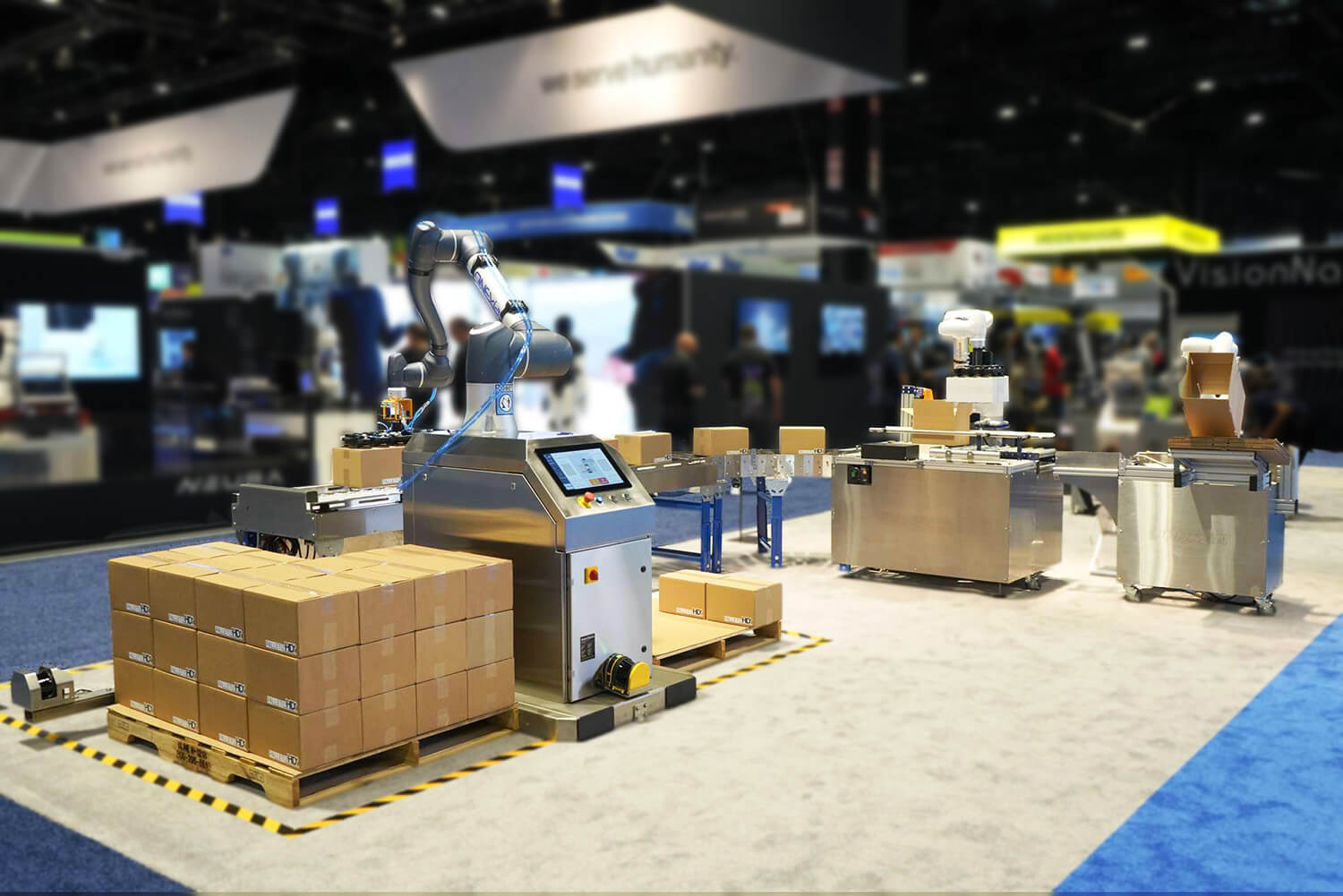
Examples include case erecting, case packing, palletizing, machine tending, pick and place, inspection, sorting, dispensing, and material handling. End-of-line applications such as case erecting, packing, and palletizing can be especially practical starting points because they often involve repetitive tasks with clearly measurable throughput requirements.
A cobot palletizer, for example, may make sense when employees repeatedly lift finished cases from a conveyor onto pallets. Automating that single step can address an ergonomic challenge while also helping maintain more consistent end-of-line throughput.
How Do You Know if a Manual Process Is Ready for Automation?
Manual process automation works best when you understand the existing process before introducing technology.
Start by documenting what happens during a normal shift. Measure cycle time, production volume, downtime, scrap, changeovers, staffing, and product variation. You should also document exceptions. If employees constantly make judgment calls because parts arrive differently every cycle, the process may need to be improved before it can be automated effectively.
NIST’s 2025 Automation 101: How to Plan for Successful Implementation recommends starting with defined automation goals and identifying projects that can have meaningful operational impact. NIST also emphasizes preparing employees for new technology and considering supporting requirements that affect long-term implementation.
This approach helps prevent a common mistake: choosing manufacturing automation technology first and then trying to find a problem for it to solve.
How Should You Evaluate Automation ROI?
ROI should include more than the number of workers currently assigned to a task.
Consider:
- Current labor hours
- Overtime and staffing challenges
- Production throughput
- Scrap and rework
- Ergonomic risk
- Downtime
- Changeover requirements
- Maintenance costs
- Training requirements
- Expected equipment life
You should also consider capacity. If a production bottleneck prevents your facility from meeting additional demand, factory automation solutions may create value by allowing existing equipment and employees to produce more.
The strongest projects usually connect the automation investment to a measurable business outcome such as higher throughput, reduced repetitive lifting, improved consistency, or additional production capacity.
Where Can Food and Beverage Manufacturers Start?
Food and beverage automation offers many opportunities because packaging operations frequently involve repetitive product handling and numerous SKU configurations.
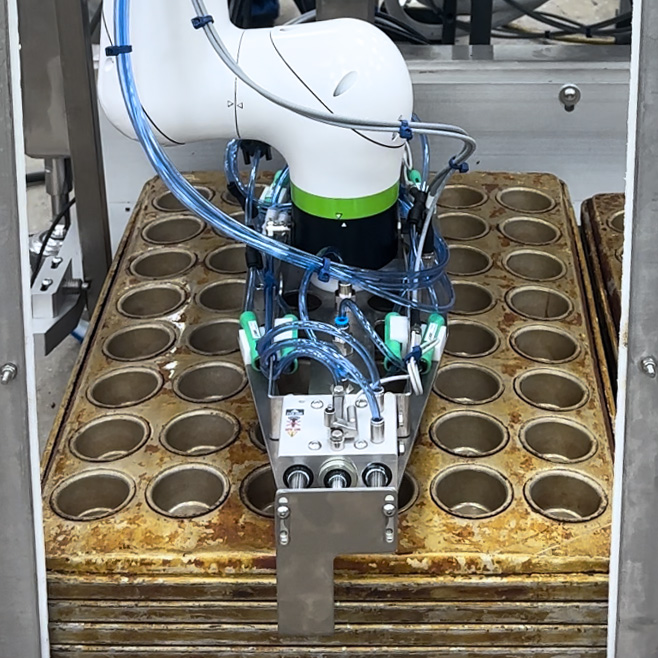
Good starting points may include case erecting, case packing, sealed package handling, and palletizing. These end-of-line processes often require employees to repeatedly handle cases, trays, buckets, or multipacks throughout a shift, making them strong candidates for automation.
Product variety also matters. If your facility changes case sizes or pallet configurations frequently, flexible automation may provide advantages over equipment designed around one fixed product format.
Robotic packaging systems can combine case erectors, case packers, conveyors, vision systems, and palletizers into a coordinated production flow. Solutions such as PalletizHD and PalletizHD+ provide manufacturers with purpose-built options for automating repetitive end-of-line palletizing applications. PalletizHD+ adds features designed for high-mix production, including zero-programming setup, automated pallet pattern creation, and faster SKU changeovers.
Food and beverage manufacturers supplying club stores and other retailers may also have specialized palletizing requirements. Retail-ready palletizing systems can be engineered around tall cases, open corrugated trays, custom tubs, and other package formats while maintaining the product orientation and presentation required for display-ready pallets.
Where Can Pharmaceutical Manufacturers Use Automation?
In pharmaceutical manufacturing, the appropriate automation opportunity may occur downstream from primary product manufacturing.
Doosan Robotics Americas focuses on secondary pharmaceutical applications rather than processes such as placing pills into bottles. Pharmaceutical automation can support activities such as placing finished bottles into cartons, case packing, handling sealed cases, palletizing, and moving packaged products between downstream operations.
These applications may involve multiple case sizes, recipe-controlled changeovers, product identification, traceability, and integration with existing automated packaging systems.
Automation does not automatically satisfy pharmaceutical validation or regulatory requirements. Your engineering, quality, and validation teams still need to determine the appropriate controls, documentation, change management, and system qualification requirements.
Where Can Plastics Manufacturers Automate?
Plastics manufacturing automation often centers on repetitive machine tending, part removal, sorting, packaging, and material handling.
A robot may remove molded components from a machine, transfer them to another operation, inspect orientation using vision, or place completed parts into packaging.
Cobots in manufacturing can be useful when production changes frequently because robotic systems can often be reprogrammed for new molds, SKUs, or packaging formats. However, the entire application still needs to be evaluated for cycle time, reach, payload, guarding, tooling, and interaction with existing machinery.
When Should You Work with a Robotic Integrator?
You should consider a robotic integrator when the project involves more than placing a robot next to an existing process.
Successful robotic systems integration may require:
- Robot selection
- Custom end-of-arm tooling
- Conveyors
- Machine vision
- Safety systems
- Electrical controls
- Custom software
- Communication with existing equipment
- Installation and commissioning
- Operator and maintenance training
Automation integrators evaluate these components as one system. Their role becomes especially valuable when you need new equipment to interact reliably with existing machines, packaging lines, production controls, or facility safety systems.
Doosan Robotics Americas combines cutting-edge technology with ONExia integrated automation solutions, such as palletizers, for defined manufacturing and end-of-line packaging applications. This includes engineered robotic palletizing systems such as PalletizHD and PalletizHD+, as well as custom automation designed around specific production and packaging requirements. The focus is on solving specific production problems with engineered systems rather than automating every process simply because automation is available.
What Questions Should You Answer Before Starting?
Before requesting an automation proposal, gather the information an engineering team will need:
- What task creates the biggest production problem?
- What are the product dimensions and weights?
- What cycle time or production rate is required?
- How many SKUs are involved?
- How frequently do products change?
- What machines must communicate with the new system?
- How much floor space is available?
- What safety and operator access requirements exist?
- What result would make the investment financially worthwhile?
Manufacturing process automation is most successful when you begin with a well defined operational challenge, establish measurable goals, and select technology around the process. Starting with one strong application can also give your team experience with automation before expanding into additional areas of the facility.
Contact us today to discuss your production challenges, automation opportunities, integration requirements, and ROI goals and identify a practical starting point for manufacturing process automation.