

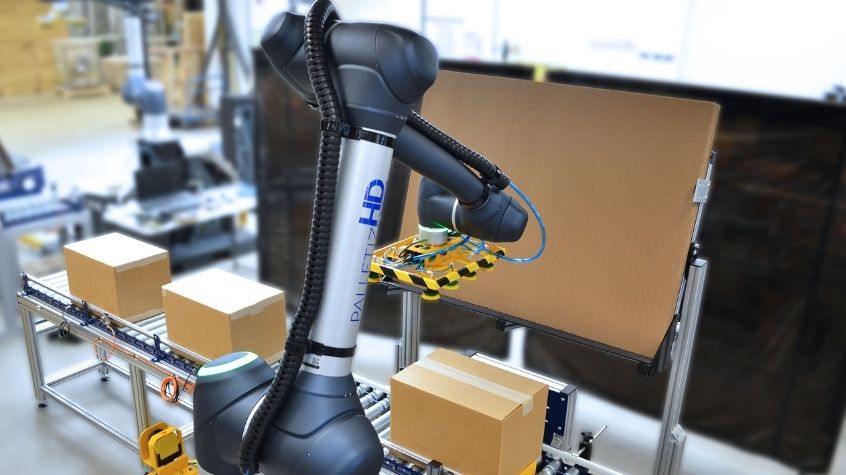
Small and mid-size manufacturers are under growing pressure to increase output without expanding headcount or floorspace. Collaborative robots, or cobots, offer a scalable and affordable solution. Built for ease of use, safety, and flexibility, they provide accessible automation that fits the needs of real-world production environments.
Below are common questions manufacturers ask when evaluating cobots. We’ll also explain how these systems can help you scale responsibly.
What are collaborative robots?
Collaborative robots are robotic arms designed to operate safely alongside human workers. With built-in sensors and force-limiting capabilities, they don’t require fencing or isolation. This allows them to support true human-robot collaboration in tight workspaces.
Because of their ease of use, cobots are especially attractive to small and mid-size manufacturers looking for automation that fits their floorplans, budgets, and workforce realities.
How are cobots different from traditional industrial robots?
Traditional robots are typically designed for high-speed, high-volume applications. They often need dedicated safety systems, programming support, and major line redesigns.
Cobots differ in important ways:
- They’re easy to program and redeploy
- They take up less space
- They cost less to integrate
- They’re designed to be safe around people
- They can be used for a variety of tasks with minimal setup
These features make cobots for small manufacturers a practical starting point for automation.
Why are cobots well suited for small and mid-size manufacturers?
Cobots offer unique value to smaller operations that need flexible, cost-effective tools to meet changing production demands. They work well in environments where space is limited and skilled labor is difficult to hire or retain.
Some key collaborative robots benefits include:
- Lower upfront investment
- Fast deployment with minimal disruption
- Support for short production runs and frequent changeovers
- Safe operation in shared work areas
- Scalable architecture to grow with your operation
Many companies are overcoming budget and workforce challenges through collaborative automation, particularly when scaling robotics for small-to-mid-sized manufacturers.
What types of tasks can cobots handle?
Cobots are most effective for repetitive, labor-intensive tasks such as:
- Machine tending
- Pick-and-place
- Packaging and labeling
- Quality inspection
- Light assembly
- End-of-line palletizing
In many cases, palletizing is a powerful entry point. It’s physically demanding and difficult to staff reliably. For small manufacturers, palletizing maximizes profit by reducing labor costs and improving consistency.
How fast can you expect a return on investment?
Cobot ROI is typically achieved in 12–18 months, depending on the application and production volume.
Key factors include:
- Number of shifts covered
- Labor costs saved
- Downtime reduced
- Flexibility for multi-task use
By focusing on high-impact applications first, many small operations find that collaborative robots pay for themselves faster than expected.
Are cobots safe to use in busy environments?
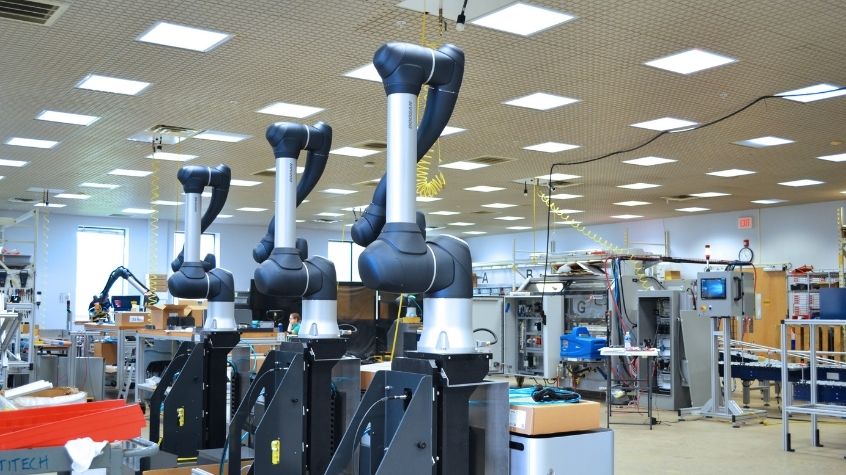
Yes. Cobots are built with integrated safety systems that comply with global safety standards. Their design allows for physical proximity to operators, making them ideal for applications that require frequent human interaction.
This safety profile enables true human-robot collaboration in areas where traditional robots would be too risky or require full enclosures.
How easy are cobots to program and manage?
Ease of use is one of the biggest drivers behind the growth of collaborative robots. Many systems offer touchscreen controls or hand-guided programming—allowing operators to teach the robot movements without coding.
This approach makes automation accessible to teams without in-house robotics expertise, allowing companies to deploy and adjust cobots using existing staff.
What holds small manufacturers back from adopting cobots?
Misconceptions are often the biggest barrier. Many manufacturers assume automation is only for large enterprises or that robotics require a full-time specialist.
Here are a few common misconceptions:
- “Robots are too expensive for small shops”
- “We don’t have the technical skills to run automation”
- “Our production isn’t consistent enough for robotics”
- “Automation means shutting down our line during installation”
These are outdated concerns. With accessible automation like Doosan collaborative robots , it’s now possible to start small and scale gradually.
Why partner with Doosan Robotics Americas?
Choosing the right integration partner is critical. Our team at Doosan Robotics Americas works with small and mid-size manufacturers to deploy cobot systems that match your operation—not overwhelm it.
Doosan Robotics Americas helps you:
- Identify the best starting point for ONExia robotic automation solutions
- Design systems tailored to your floor space and workflow
- Provide ongoing support after deployment
- Build custom machines when off-the-shelf equipment doesn’t fit
- Scale automation over time with confidence
How should you evaluate automation integrators?
When evaluating automation integrators for your business, the most important thing is to understand your goals.
The right partner will:
- Speak your language, not just engineer jargon
- Understand the constraints of smaller operations
- Deliver fast, low-risk implementations
- Offer long-term service and support
A good integrator makes automation work for you, not the other way around.
Is now the right time to invest in cobots?
If you’re struggling to hire, battling turnover, or missing production targets due to repetitive tasks, it might be time to ask: is it time to invest in automation?
Cobots allow you to solve today’s challenges while building a foundation for growth. Even automating one task can make a measurable difference.
What’s the next step?
Start small. Automate a single process that creates a bottleneck or burns out your staff. Doosan Robotics Americas will help you identify where a ONExia cobot can make the biggest impact first.
Ready to scale your operation responsibly? Contact us to start a conversation about bringing collaborative automation to your operation in a way that fits your space, team, and production goals.